

I. Abnormal Climate: The “Hidden Culprit” behind the Frequent Occurrence of Respiratory Diseases
In recent years, the global climate has shown a significant abnormal fluctuation trend. Sudden rises and drops in temperature, increasing temperature differences between day and night, and frequent extreme weather events have become the norm. This unstable climatic condition not only disrupts the balance of the natural ecosystem but also becomes an important trigger for various respiratory diseases. Medical research shows that when the temperature fluctuates frequently, the defense function of the human respiratory tract mucosa will significantly decline, making it easier for viruses, bacteria and other pathogens to invade the respiratory tract and multiply in large numbers, leading to a sharp increase in the incidence of diseases such as colds, flu and bronchitis.
Meanwhile, abnormal climate can also affect the quality of the atmospheric environment. High temperatures and changes in humidity may exacerbate air pollution, increasing the concentrations of allergens such as PM2.5, pollen and dust mites in the air, further irritating the respiratory tract and triggering acute attacks of diseases such as asthma and allergic rhinitis. During the winter of 2024-2025, many regions in China witnessed a sharp increase in the number of patients seeking medical treatment for respiratory diseases due to the alternation of sudden drops and warming temperatures. Among them, children, the elderly, and people with weakened immune systems were the main affected groups. This phenomenon highlights the urgency of building a rapid and accurate respiratory disease diagnosis system in the context of climate change.
Ii. Current Situation and Pain Points of Respiratory Disease Diagnosis: Precise detection is the key to prevention and control
At present, the clinical diagnosis of respiratory diseases mainly relies on symptom observation, imaging examinations and laboratory tests. However, due to the highly similar symptoms caused by various respiratory pathogens (such as influenza virus, novel coronavirus, respiratory syncytial virus, etc.), it is difficult to accurately distinguish the type of pathogen merely based on clinical manifestations such as fever, cough, and sore throat, which can easily lead to misdiagnosis or missed diagnosis. Although traditional single-pathogen detection methods (such as influenza virus detection and COVID-19 antigen detection) are easy to operate, they can only target one or two pathogens in a single test, which cannot meet the clinical demand for rapid screening of multiple pathogens.
During the high-incidence season of diseases, patients often need to undergo multiple tests to determine the cause of the disease. This not only prolongs the diagnosis time and increases medical costs, but may also aggravate the condition due to delayed treatment. Furthermore, for primary medical institutions, the lack of efficient multi-test tools will limit their precise diagnosis and treatment capabilities for respiratory diseases and affect the implementation of the hierarchical medical treatment policy. Therefore, developing a rapid detection product capable of simultaneously identifying multiple common respiratory pathogens has become a key breakthrough for enhancing the efficiency of respiratory disease prevention and control.
Iii. Sejoy Ten Respiratory Pathogens Antigen Combo Test Kit: An Innovative Breakthrough in Multi-in-one Detection Technology
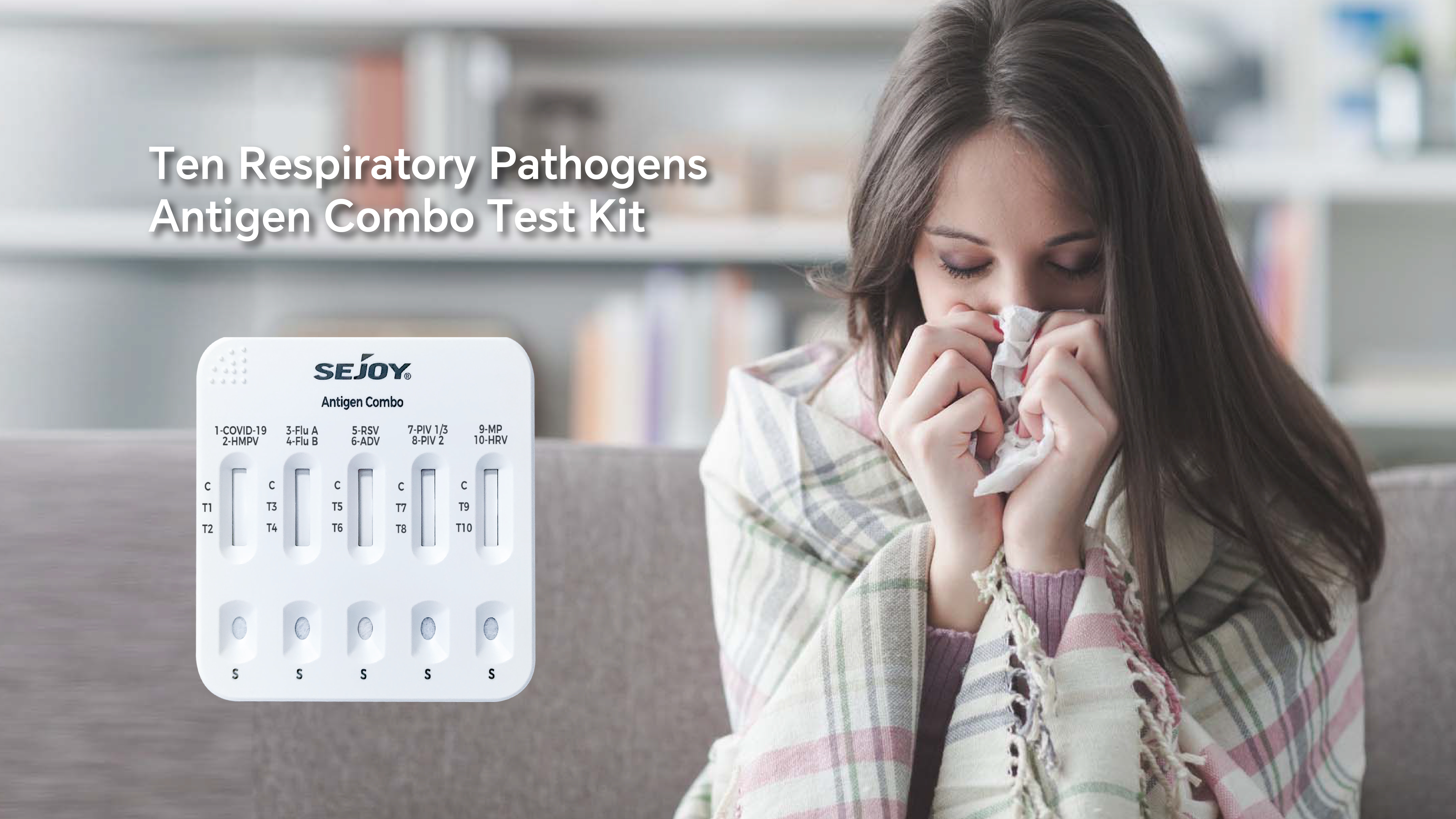
In response to the current pain points in respiratory disease diagnosis, Sejoy (Xerox Hui) has launched a new product, the Ten-in-One respiratory pathogen detection reagent card. This product adopts advanced immunochromatography technology to achieve one-time rapid detection of 10 common respiratory pathogens, providing an efficient and convenient solution for clinical diagnosis.
(1) Core Technology: Analysis of the Advantages of Immunochromatography Technology
Immunochromatography is a rapid detection technique based on the specific binding reaction between antigens and antibodies. Its principle is to fix antibodies against specific pathogen antigens on nitrocellulose membranes. When the sample to be tested (such as nasopharyngeal swabs) is dropped into the sample hole of the test strip, the antigen in the sample will combine with the colloidal gold-labeled antibody to form an immune complex. And it moves towards the detection area under the action of chromatography. If the target antigen is present in the sample, the immune complex will combine with the antibody in the detection area, forming a visible color band to the naked eye, thereby achieving qualitative detection.
This technology has advantages such as simple operation, rapid detection, and no need for special equipment: during the detection, only a nasopharyngeal swab sample needs to be collected, and after adding the lysis buffer, it is dropped into the reagent card. The result can be observed within 15 to 20 minutes. The entire process does not require professional laboratory equipment and can be used in primary medical institutions, community clinics, and even home scenarios. Meanwhile, the specificity and sensitivity of immunochromatography technology have been strictly verified, which can effectively avoid cross-reactions and ensure the accuracy of the test results.
(2) Comprehensive coverage: All ten pathogens are caught in one go
The Sejoy Respiratory Ten-in-One Test reagent card can simultaneously detect 10 common respiratory pathogens in clinical practice, specifically including:
SARS-CoV-2 Antigen (Novel Coronavirus antigen)
Influenza A virus Antigen
Influenza B virus Antigen
RSV Antigen (Respiratory syncytial virus antigen)
ADV Antigen (adenovirus antigen)
HMPV Antigen (Human metapneumovirus antigen)
MP Antigen (Mycoplasma pneumoniae antigen
PIV 1/3 Antigen (parainfluenza virus type 1/3 antigen)
PIV 2 Antigen (parainfluenza virus type 2 antigen)
HRV Antigen (Human Rhinovirus antigen
These pathogens cover the major viruses and mycoplasma that cause respiratory tract infections, including seasonal influenza, COVID-19, RSV infection common in children, and the important pathogen MP of community-acquired pneumonia in adults. Through a one-time test, the type of pathogen that the patient is infected with can be quickly identified, providing a scientific basis for doctors to formulate targeted treatment plans (such as antiviral treatment, antibiotic use, etc.) and avoiding blind medication.
(3) Product advantages: High efficiency, convenience and precise clinical value
Efficiency: A single test covers 10 types of pathogens, significantly reducing the diagnosis time from several hours or even a day for traditional multiple tests to within 20 minutes, thus buying precious treatment time for patients.
Convenience: No professional equipment is required. The operation steps are simple (sample collection → sample addition → waiting for results). Grassroots medical staff can master it after simple training. It is suitable for use in scenarios with limited medical resources.
Accuracy: By using highly specific monoclonal antibodies, the detection sensitivity and specificity for 10 pathogens both meet clinical requirements, effectively reducing false positive and false negative results.
Economy: Compared with multiple single tests, the ten-in-one test reagent card reduces the average testing cost per person, alleviates the economic burden on patients, and at the same time reduces the waste of medical resources.
Wide applicability: It is suitable for all kinds of medical institutions (hospitals, community health service centers, clinics, etc.), as well as public health scenarios such as epidemic prevention and control and screening of mass infection events.
Iv. Product Application Scenarios: Comprehensive coverage from clinical diagnosis and treatment to public health prevention and control
The Sejoy Respiratory ten-test reagent card, with its efficient and convenient features, can be widely applied in the following scenarios:
Emergency departments and fever clinics in hospitals: Quickly distinguish pathogens such as influenza, COVID-19, and RSV to prevent cross-infection and optimize patient triage management.
Primary medical institutions: Enhance the diagnostic capabilities of complex respiratory tract infections at the grassroots level, facilitate the implementation of the hierarchical medical system, and reduce unnecessary referrals.
Schools and kindergartens: Conduct group screening during respiratory disease outbreaks to quickly identify the source of infection and prevent the spread of the epidemic.
Home self-testing: High-risk groups (such as the elderly and patients with chronic diseases) can conduct tests at home to detect infections in a timely manner and seek medical treatment, reducing the risk of severe illness.
Public health emergency response: In the event of a sudden outbreak of respiratory infectious diseases, it serves as a rapid screening tool to assist disease control departments in grasping the epidemic situation.
V. Sejoy Brand Strength: Focusing on in vitro diagnostics, safeguarding a healthy life
As an innovative enterprise deeply engaged in the field of in vitro diagnostics, Sejoy has always been committed to the mission of “Technological innovation, safeguarding health”, and is dedicated to providing high-quality diagnostic products for global users. The company has a professional R&D team and an advanced production base. It strictly adheres to the ISO13485 quality management system to ensure that the entire process of product development, production and sales is compliant and controllable. The newly launched respiratory ten-in-one test reagent card is another significant achievement of Sejoy in the field of respiratory pathogen detection, demonstrating the company’s profound insight into clinical needs and technological innovation capabilities.
In the future, Sejoy will continue to focus on the cutting-edge development of in vitro diagnostic technology, and develop more innovative products that meet clinical needs in areas such as infectious diseases, chronic disease management, and health screening, contributing to the improvement of global medical and health standards.
Vi. Conclusion: Addressing Climate Challenges and Building the “First Line of Defense” for Respiratory Health
Against the backdrop of frequent respiratory diseases caused by abnormal climate, the launch of the Sejoy Respiratory ten-in-One test reagent card has provided clinical practice with a “more, faster, better and more cost-effective” testing solution. By detecting 10 types of pathogens at one time, this product not only solves the problems of low efficiency and narrow coverage of traditional detection methods, but also provides strong support for precise diagnosis and treatment as well as epidemic prevention and control. Both medical institutions and individuals can quickly grasp the pathogen information of respiratory tract infections through this innovative tool, achieving “early detection, early diagnosis and early treatment”.
In the face of the health challenges brought about by climate change, we need to rely on technological innovation to build a more complete disease prevention and control system. The promotion and application of Sejoy Respiratory Ten-in-One Test reagent cards will inject new impetus into safeguarding public respiratory health, helping us gain the initiative in the fight against respiratory diseases and enabling everyone to have a more solid health guarantee in the ever-changing climate environment.
Choose Sejoy Respiratory Ten-Check, one test, comprehensive peace of mind – safeguarding the respiratory health of you and your family!
Post time: Dec-01-2025