

When reviewing a complete blood count (CBC) report, three closely related parameters—red blood cell (RBC) count, hemoglobin (Hb), and hematocrit (Hct)—often cause confusion for both clinicians and patients: Is a simultaneous decrease in all three always a sign of anemia? Why might Hb levels appear normal while Hct is abnormal? By clarifying the definitions, interrelationships, and validation principles of these indicators, we can avoid diagnostic errors and make optimal clinical decisions.
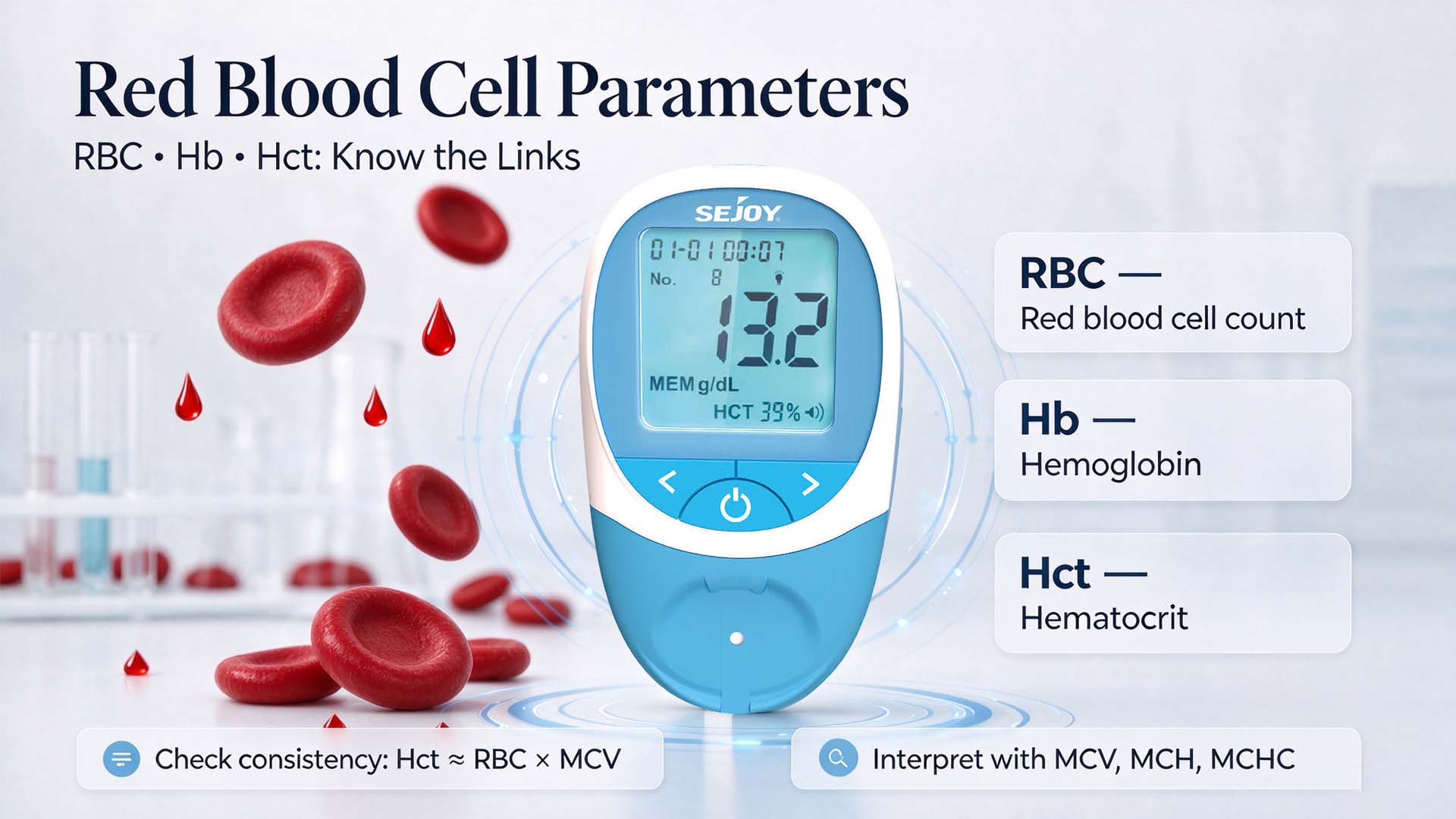
RBC count quantifies the total number of red blood cells per unit volume of blood, representing the cellular component responsible for oxygen transport. Hb is the iron-containing protein within red blood cells that binds and carries oxygen, directly determining the blood’s oxygen-carrying capacity. Hct measures the proportion of total blood volume occupied by red blood cells, reflecting both the number and size of erythrocytes. These three parameters are inherently linked by well-established hematological formulas: Hct is approximately equal to RBC count multiplied by mean corpuscular volume (MCV), while Hb equals RBC count multiplied by mean corpuscular hemoglobin (MCH). Their patterns of change provide critical diagnostic clues: a parallel reduction in all three typically indicates classic anemia such as iron deficiency anemia; an isolated decrease in Hb with normal RBC count suggests chronic blood loss or impaired hemoglobin synthesis; and elevated Hct with normal Hb often points to hemoconcentration caused by dehydration.
Three core rules govern the reliable interpretation of these parameters. First, numerical consistency must be verified: the calculated Hct (RBC × MCV) should align with the measured Hct, with discrepancies exceeding 3% indicating potential pre-analytical errors such as specimen hemolysis or clotting, or analytical instrument malfunctions. Second, unit conversion pitfalls should be avoided: while Hct is reported as L/L in most domestic systems, a value of 0.45 L/L is equivalent to 45%, requiring no conversion, but Hb is measured in g/L in China and g/dL in some international systems, where 140 g/L corresponds to 14 g/dL. Special attention is required when interpreting Hct values above 0.52 L/L, which necessitates investigation for polycythemia vera. Third, these parameters should always be interpreted in conjunction with erythrocyte indices including MCV, MCH, and mean corpuscular hemoglobin concentration (MCHC) to classify anemia subtypes and identify underlying etiologies.
In clinical practice, these indices support diverse diagnostic and monitoring applications. For anemia classification, iron deficiency anemia presents with mild RBC reduction, disproportionately severe Hb decrease, and low Hct, accompanied by MCV <80 fl, MCH <27 pg, and serum ferritin <15 μg/L. Hemolytic anemia shows the characteristic paradox of reduced RBC count alongside elevated reticulocyte count (>3%), plus increased lactate dehydrogenase and free hemoglobin, and decreased haptoglobin. For surgical risk assessment, preoperative Hb <70 g/L is an indication for perioperative transfusion, while elevated Hct increases the risk of intraoperative thromboembolic events. Hemoglobin testing is a mandatory pre-operative assessment to guide transfusion planning and reduce surgical risk. In chronic disease management, chronic kidney disease-related anemia presents with parallel reduction of RBC, Hb, and Hct due to decreased erythropoietin production, requiring regular hemoglobin meter to monitor treatment response and maintain Hb within the target range of 100–120 g/L, as levels above this threshold increase thrombotic risk. For patients with suspected congenital hemoglobinopathies, hemoglobin measurements using high-performance liquid chromatography enables identification of abnormal hemoglobin variants that may cause discrepancies between Hb levels and clinical symptoms.
When abnormal results are encountered, a standardized workflow should be followed: first, verify the logical consistency of the parameters by checking whether Hct approximates RBC × MCV. Second, correlate results with clinical history: recent bleeding suggests acute blood loss, while gastrointestinal symptoms indicate potential iron or vitamin B12 deficiency. Third, order supplementary tests including reticulocyte count and iron metabolism panel as needed. Finally, implement tiered reporting: critical values (Hb <50 g/L) require immediate notification of clinical staff, with notes on potential interfering factors such as lipemia or cold agglutination. Mastering these principles enables clinicians to accurately interpret red cell indices, make timely diagnoses, and optimize patient management.
Post time: Nov-20-2026