

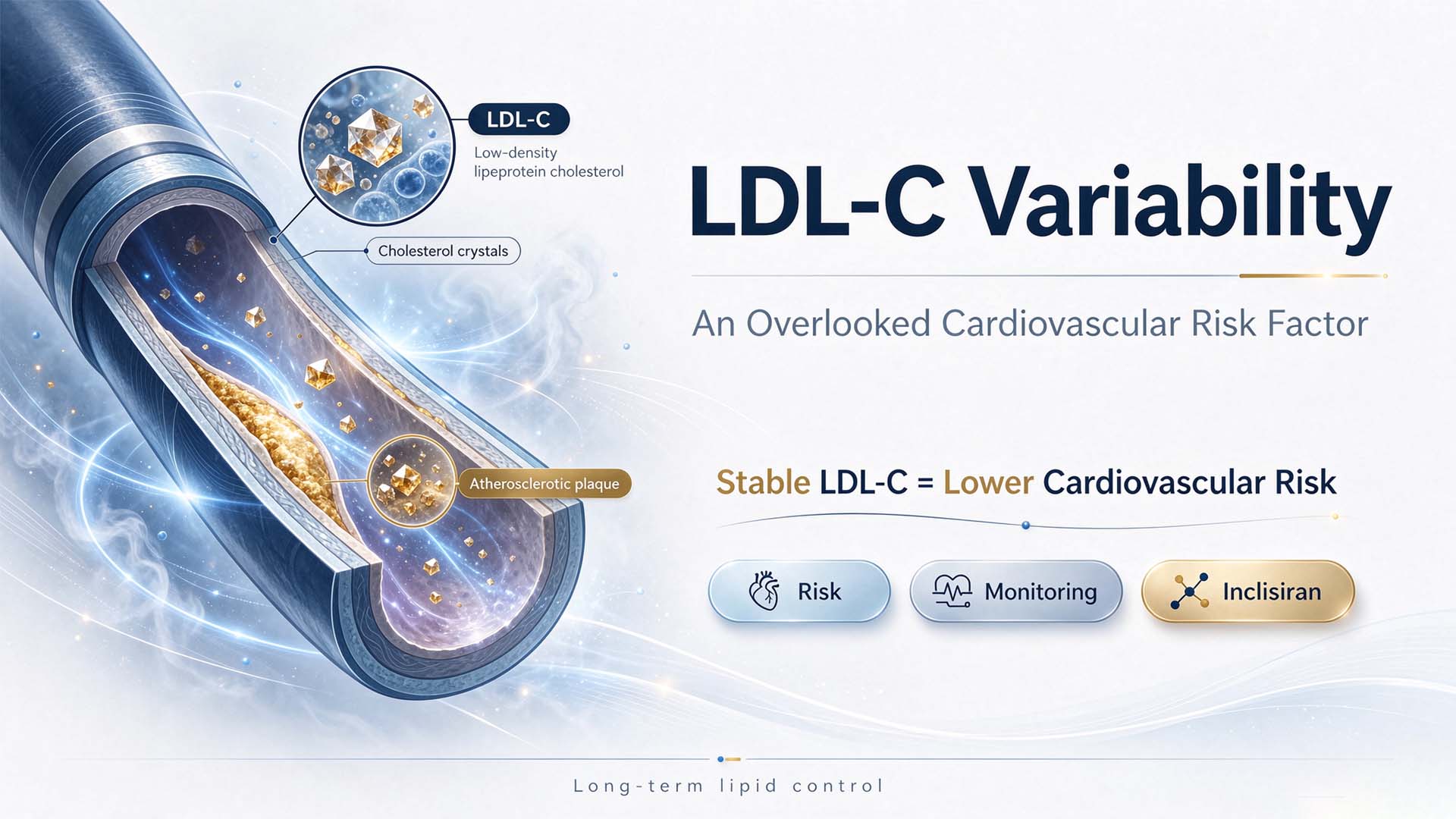
Since the 1960s, accumulating evidence has highlighted that high lipid variability is closely associated with increased cardiovascular disease (CVD) risk, with the 1994 Framingham Heart Study first confirming a positive correlation between cholesterol level variability and CVD morbidity and mortality. Subsequent analysis of the TNT trial in 2015 further identified low-density lipoprotein cholesterol (LDL-C) variability as an independent risk factor for recurrent cardiovascular events, sparking widespread clinical attention to this previously underrecognized marker. LDL-C variability refers to the fluctuation of LDL-C measurements in the same individual over time, quantified by indicators including average successive variability (ASV), standard deviation (SD), coefficient of variation (CV), and variability independent of the mean (VIM).
Mounting research confirms that high LDL-C variability directly contributes to the initiation and progression of atherosclerosis. It impairs vascular endothelial function, destabilizes atherosclerotic plaques, and accelerates plaque growth, significantly increasing the risk of plaque rupture and acute cardiovascular events. A pooled analysis of 9 clinical studies including 4,976 patients with coronary heart disease (CHD) found that each SD increase in LDL-C variability was associated with a 9% higher risk of plaque volume progression. Another Japanese retrospective study comparing 74 acute coronary syndrome (ACS) patients with 222 patients without stenosis demonstrated that elevated LDL-C variability, measured by corrected VIM (cVIM), was linked to increased plaque rupture risk, likely due to repeated cholesterol crystallization and dissolution driven by fluctuating LDL-C levels. Notably, the TNT trial analysis of 9,572 CHD patients revealed that high LDL-C variability was associated with significantly increased cardiovascular event risk regardless of absolute LDL-C levels, emphasizing its independent predictive value.
Accurate, long-term monitoring of LDL-C fluctuations, enabled by reliable lipid panel analyzer, is critical for identifying patients at risk of high variability. Modern handheld lipid device platforms provide precise, consistent measurements across multiple time points, allowing clinicians to reliably calculate variability metrics and detect subtle fluctuations that may signal elevated cardiovascular risk. This precise monitoring is particularly important given that multiple factors contribute to LDL-C variability, including diet, lifestyle, comorbidities, genetic polymorphisms of LDL receptors, and most importantly, adherence to lipid-lowering therapy. A retrospective analysis of 2,641 statin users found a significant positive correlation between poor medication adherence (medication possession ratio <80%) and higher LDL-C variability (P<0.0001), confirming that inconsistent treatment is a major driver of unstable lipid levels. Long-term follow-up data further support this association: in 1,792 patients with a history of percutaneous coronary intervention (PCI), each SD increase in LDL-C variability was associated with a 34% higher risk of major adverse cardiovascular and cerebrovascular events (MACCE), underscoring the clinical urgency of improving treatment adherence to reduce variability.
Inclisiran, the first globally approved small interfering RNA (siRNA) cholesterol-lowering agent, addresses the challenge of poor adherence through its novel mechanism and infrequent dosing regimen. By leveraging the endogenous RNA interference pathway, inclisiran blocks hepatic PCSK9 protein synthesis upstream, upregulates LDL receptor expression, and produces sustained LDL-C reduction. Clinical trial data confirm its robust efficacy: the ORION-10 study in 1,561 atherosclerotic cardiovascular disease (ASCVD) patients showed a 54% LDL-C reduction with inclisiran compared to placebo; the ORION-18 trial China subgroup demonstrated a 61% LDL-C reduction in Chinese ASCVD or high-risk patients; and the 3-year open-label extension ORION-8 study confirmed that inclisiran maintained approximately 50% LDL-C reduction for up to 6 years, with 80% of patients achieving guideline-recommended LDL-C targets. Real-world data further show high treatment adherence, with 95% of patients completing the second dose and 84% completing the third dose, effectively minimizing treatment gaps that drive LDL-C variability.
Moving forward, the integration of advanced blood lipid monitor technology for long-term variability monitoring and novel therapies like inclisiran will enable clinicians to implement more personalized, sustainable lipid management strategies, reducing cardiovascular event risk through both effective LDL-C lowering and minimal variability.
Post time: Nov-12-2026