

Do you often feel inexplicably weak in your busy work? Do you get out of breath more easily than your peers when climbing stairs? These seemingly ordinary physical signals may be pointing to a overlooked health hazard – abnormal hemoglobin. As the core component responsible for transporting oxygen in human blood, the level of hemoglobin directly affects the functional state of all organs in the body. According to the World Health Organization, approximately 2 billion people worldwide have varying degrees of abnormal hemoglobin problems, among which iron deficiency anemia accounts for as high as 50%. The traditional testing method requires queuing up at the hospital for blood tests and waiting for several hours to obtain results. This inefficient model has caused many people to miss the opportunity for early intervention. Nowadays, the emergence of the Sejoy portable hemoglobin analyzer has completely changed this situation. With just a drop of blood from your fingertip, a precise test can be completed in 15 seconds, making blood health management easy and convenient from now on.
1. Hemoglobin: The “oxygen Transport captain” of human health
Hemoglobin (Hb) is a core functional protein within red blood cells. Its main function is to take in oxygen from the lungs and transport it to all tissues and organs throughout the body, while also bringing back carbon dioxide produced by metabolism to the lungs for excretion. The reference range for hemoglobin in normal adult males is 120-160g/L, for females it is 110-150g/L, and for newborns it can be as high as 170-200g/L. Behind this seemingly simple figure lies the mystery of human metabolism.
The circadian rhythm of hemoglobin shows obvious physiological fluctuations. In healthy individuals, it reaches the highest value of the day around 8 a.m. and drops to the lowest point around 8 p.m. The fluctuation range is usually between 5 and 10g/L. It is worth noting that the hemoglobin levels of long-term smokers are generally high. This is because the carbon monoxide in cigarettes combines with hemoglobin to form carboxyhemoglobin, causing the body to compensate for hypoxia by increasing hemoglobin synthesis. However, due to their physiological characteristics, the hemoglobin levels of children, the elderly and pregnant women are slightly lower than those of ordinary adults. Among them, pregnant women may develop physiological dilution anemia in the middle and late stages of pregnancy due to increased blood volume.
In clinical diagnosis, hemoglobin testing has irreplaceable value. Anemia can be diagnosed when the hemoglobin concentration is lower than 110g/L. Compared with red blood cell count, hemoglobin measurement can more accurately reflect the degree of anemia: 90-110g/L for mild anemia, 60-90g/L for moderate anemia, and less than 60g/L for severe anemia. Different types of anemia show characteristic differences in the ratio of changes in hemoglobin to red blood cell count: the decrease in hemoglobin in patients with iron deficiency anemia is significantly greater than the reduction in red blood cell count. Megaloblastic anemia, on the other hand, is characterized by a significant reduction in red blood cell count and a relatively gentle decrease in hemoglobin. This difference provides an important basis for clinicians to determine the type of anemia.
2. Abnormal hemoglobin: A health hazard lurking in the blood
Hemoglobin is like the “oxygen express system” of the human body. Abnormal levels of hemoglobin can trigger a series of chain reactions and have a profound impact on the functions of all organs in the body. When the hemoglobin level is below the normal range, the various tissues and organs of the body do not receive sufficient oxygen supply, and typical anemia symptoms will occur.
Patients with mild anemia often present with symptoms such as easy fatigue, inattention, and pale skin and mucous membranes. These seemingly minor discomforts are often attributed to “sub-health” or “excessive work fatigue”. As the degree of anemia worsens, symptoms such as dizziness, tinnitus, palpitations and shortness of breath may occur, and the exercise endurance will significantly decline. Long-term moderate to severe anemia can lead to compensatory hypertrophy of the myocardium and even cause anemic heart disease. For children, iron deficiency anemia can directly affect brain development, leading to a decline in cognitive ability and lagging academic performance. Studies show that the average IQ score of children with anemia is 5 to 8 points lower than that of normal children, and this cognitive impairment may be irreversible.
In contrast to anemia is a high level of hemoglobin, which is also a warning sign of health. When hemoglobin remains consistently above 160g/L (for women) or 170g/L (for men), blood viscosity will significantly increase, blood flow speed will slow down, making it easy for blood clots to form and increasing the risk of cardiovascular and cerebrovascular diseases. The causes of elevated hemoglobin include long-term smoking, chronic obstructive pulmonary disease, sleep apnea syndrome and other chronic hypoxia conditions, as well as hematological diseases such as polycythemia vera. It is particularly important to note that a false increase in hemoglobin can also occur in a dehydrated state, which is more common among people who sweat profusely, such as those working in high temperatures and long-distance runners.
3. These groups of people, in particular, need to pay attention to their hemoglobin levels
Hemoglobin testing is not exclusive to anemia patients. The following groups of people, due to their physiological characteristics or disease risks, need regular monitoring of hemoglobin levels and the establishment of personalized health management plans even more.
Pregnant and postpartum women are the key population for hemoglobin testing. During pregnancy, a woman’s blood volume increases by 30% to 45%, and the production of red blood cells lags behind, making her prone to “physiological anemia”. The incidence of anemia during pregnancy in China is as high as 19.1%, among which iron deficiency anemia accounts for 95%. Severe anemia during pregnancy increases the risk of premature birth and low birth weight infants, and may also lead to intrauterine hypoxia in the fetus. Therefore, the WHO recommends that pregnant women test their hemoglobin every 8 to 12 weeks starting from the second trimester, maintaining the level above 110g/L.
Children and adolescents are in a critical period of growth and development, and the level of hemoglobin directly affects brain development and physical growth. The period from 6 months to 6 years old is a high-incidence period for iron deficiency anemia in children, which is closely related to factors such as improper addition of complementary foods and rapid growth. Studies show that the height growth rate of children with anemia is 2 to 3 centimeters per year slower than that of normal children. Schools and kindergartens should incorporate hemoglobin testing into regular physical examination items to achieve early detection and early intervention.
As the elderly age, their gastrointestinal absorption function declines and their hematopoietic function drops. Coupled with the influence of chronic diseases, the incidence of anemia increases significantly. The prevalence of anemia among people over 65 years old is 10% to 20%, among which about one third are iron deficiency anemia. Anemia in the elderly often presents with non-specific symptoms such as fatigue, decreased activity ability and cognitive decline, which are easily mistaken for normal aging phenomena. Regular testing of hemoglobin helps to detect potential diseases at an early stage, such as gastrointestinal bleeding and malignant tumors.
In addition, long-term vegetarians, athletes, patients with chronic kidney disease, and those undergoing radiotherapy and chemotherapy for tumors also need to regularly monitor their hemoglobin levels based on their own conditions. For vegetarians, since the absorption rate of plant-based iron is only 1% to 2% (while that of animal-based iron is 15% to 35%), it is recommended to have a test every 3 to 6 months. Athletes undergoing high-intensity training may have increased red blood cell destruction or excessive iron loss and need to be monitored every 2 to 3 months.
4. Sejoy Portable Hemoglobin Analyzer: Four major advantages Redefine blood testing
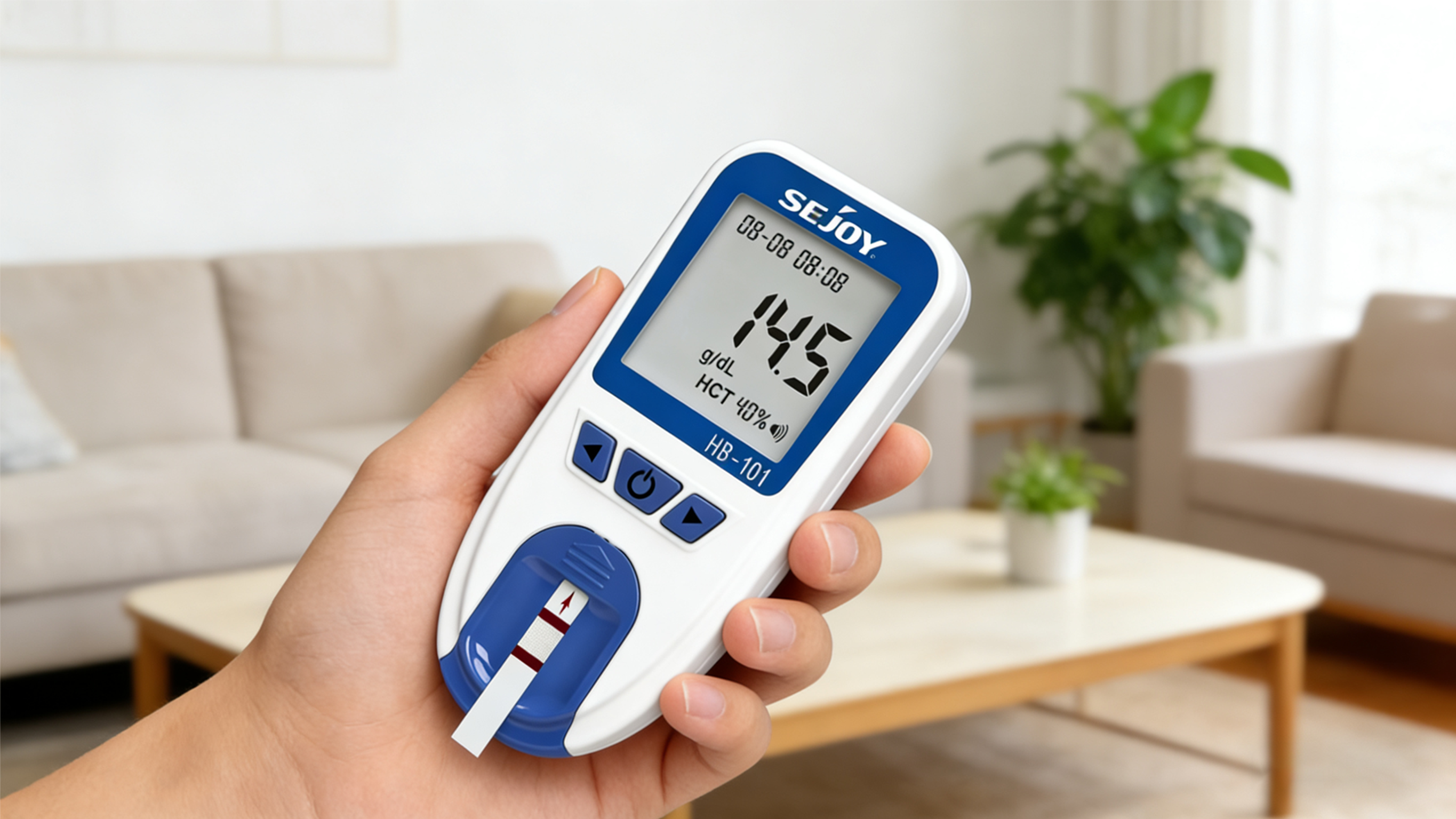
Facing the numerous inconveniences of traditional hemoglobin testing, the Sejoy portable hemoglobin monitor, with its innovative technology and humanized design, has brought a revolutionary breakthrough to blood health testing. This detection device, which integrates precision, speed and convenience, adopts the advanced dry chemical method principle. It can complete the detection by simply drawing blood from the fingertip, completely breaking the limitations of time and space.
The precise and reliable detection performance is the core advantage of the Sejoy analyzer. This device adopts microfluidic chip technology to precisely react blood samples with reagents and measure the concentration of hemoglobin through an optical detection system. Certified by the State Food and Drug Administration, the error range of its test results is controlled within ±1g/dL, and the correlation with the hospital’s fully automatic biochemical analyzer is above 0.98. In clinical validation, the Sejoy analyzer’s detection of 1,000 samples with different hemoglobin levels showed an accuracy rate as high as 97.3%, fully meeting the clinical diagnostic requirements.
The feature of providing results within 15 seconds has completely transformed the waiting experience of traditional testing. Traditional hospital testing usually takes 1 to 2 hours from blood collection to obtaining the report. However, the Sejoy analyzer can complete the test in just three steps: Use the accompanying low-pain blood collection needle to collect a drop of fingertip blood (about 10μL), add the blood sample to the test strip, and the test result will be displayed within 15 seconds after the instrument is inserted. This immediate detection capability is particularly important in emergency situations, such as prenatal check-ups for pregnant women and pre-competition physical fitness assessments for athletes.
The painless blood collection design makes the testing process no longer intimidating. The blood collection needle that comes with Sejoy uses a 30G ultra-fine needle tip. The needle tip has undergone special grinding treatment, and the puncture depth is precisely controlled at 1.8mm. The pain score is only 1.2 points (VAS Visual Analogue scale, 0 points for no pain, 10 points for severe pain). Many children reported “almost no pain” after the test, which greatly improved the compliance of the test, especially suitable for children and people who are sensitive to pain.
The extremely portable design makes health monitoring ubiquitous. The Sejoy analyzer weighs only 120g and measures 110×65×25mm, which is about the size of a smart phone and can be easily put in a pocket or handbag. The device is equipped with a rechargeable lithium battery, which can perform 200 consecutive tests on a single charge and has a standby time of up to 30 days. Whether it’s mobile physical examinations at community medical points, health screenings at schools, or medical support in remote mountainous areas, the Sejoy analyzer can handle them all, truly achieving “test anytime, anywhere, whenever you want”.
5. Applicable scenarios: Comprehensive coverage from families to medical institutions
The application scenarios of the Sejoy portable hemoglobin analyzer are extremely extensive. Whether it is personal and family health management or clinical testing in professional medical institutions, it can play an important role and provide customized testing solutions for different groups of people.
In the field of maternal and child health care, the Sejoy analyzer has become a powerful assistant for perinatal care. By equiving this device, the community health service center has extended the prenatal hemoglobin test from the hospital to the community. Pregnant women only need to walk for 10 minutes to complete the test, and the results are available immediately. In a certain pilot community, after using the Sejoy analyzer, the coverage rate of anemia screening for pregnant women increased from 68% to 92%, and the timely rate of anemia intervention rose by 40%. Midwife Xiao Li shared, “Previously, pregnant women had to make two trips to the hospital for a hemoglobin test. Now, it can be done in the community, which has greatly improved compliance.”
School physical examinations are another important application scenario for the Sejoy analyzer. In traditional physical examinations, hemoglobin testing requires venous blood collection, which not only takes a long time but also easily causes panic among children. A certain primary school conducted a school-wide physical examination using the Sejoy analyzer. All 500 students completed the tests in just three hours. When the children were queuing up for the tests, they were even full of anticipation. Doctor Wang, the school doctor, said, “Fingertip blood collection is almost painless. Children no longer cry and fuss. The testing efficiency has increased by three times, and the data can be uploaded to the health record system in real time.”
In terms of primary healthcare, the Sejoy analyzer provides high-quality testing resources for remote areas. After a mountainous health center in Yunnan Province was equipped with this device, it achieved the goal of “minor illnesses treated within the village and early detection of anemia”. Old Zhang, a village doctor, said with emotion, “In the past, villagers had to walk for two hours along the mountain path to the town for blood tests. Now, they can get tested at the village clinic. If any abnormality is found, they can intervene immediately. Last year, the anemia rate among children in our village dropped by 15%.”
The field of sports medicine has also benefited a lot from the Sejoy analyzer. Professional sports teams use it as a daily training monitoring tool. By regularly testing the hemoglobin levels of athletes, they scientifically adjust the training intensity and nutrition plans. The team doctor of a provincial track and field team introduced: “The hemoglobin level of endurance athletes is closely related to their sports performance. We test it once a week. When the level is found to be lower than 140g/L, we will adjust the training plan and supplement iron, effectively preventing exercise-induced anemia.”
For patients with chronic diseases, the Sejoy analyzer is a great helper for self-management at home. Patients with diabetic nephropathy are prone to renal anemia and need regular monitoring of hemoglobin. Aunt Li, a patient, said, “Previously, I had to go to the hospital every month to have my blood tested for hemoglobin. Now, I can measure it at home by myself and send the results to the doctor through an APP. The doctor can adjust the dosage of erythropoietin remotely. It’s much more convenient.”
6. A New Era of Health Management: Make hemoglobin Testing a daily habit
The level of hemoglobin is an important window reflecting the health status of the human body. Regular testing should not only be a passive choice under disease conditions, but also become a part of active health management. The emergence of the Sejoy portable hemoglobin analyzer has made this proactive health management possible. It is not only a detection device but also the key to unlocking a scientific and healthy lifestyle.
Establishing the habit of regular testing is the foundation for maintaining blood health. The testing frequency for different groups of people should vary: ordinary adults should be tested at least once a year. Pregnant women should be tested once every 8 to 12 weeks starting from the second trimester. Children should be tested once every six months. Patients with chronic diseases and the elderly should be tested once every three months. Vegetarians, athletes and other special groups are advised to get tested every 2 to 3 months. Fixing the test time in the morning on an empty stomach can reduce the impact of physiological fluctuations on the results and facilitate longitudinal comparison.
The scientific interpretation of the test results is equally important. When the detected value is lower than the normal range, a comprehensive judgment should be made in combination with factors such as diet and symptoms. Mild iron deficiency anemia can be improved by increasing the intake of iron-rich foods such as red meat, animal liver and spinach. For moderate to severe anemia, iron supplements should be taken under the guidance of a doctor. For cases with elevated hemoglobin levels, it is necessary to rule out chronic hypoxia, dehydration and other causes. Smokers should consider quitting smoking, while residents in high-altitude areas need to pay attention to the risk of polycythemia.
With the development of mobile healthcare, the Sejoy analyzer can be connected to a mobile phone APP via Bluetooth, automatically record each test result, generate a hemoglobin change curve, and visually display health trends. The APP also offers personalized health advice, such as recommending iron-rich recipes and exercise plans based on test results. This closed-loop management model of “detection – analysis – intervention” makes blood health management more scientific and efficient.
In this era that values health, the Sejoy portable hemoglobin analyzer, with its precise, rapid and convenient features, is changing people’s perception of blood testing. It enables tests that once needed to be conducted in hospitals to now be easily carried out in homes, schools and communities. Let the results that once required waiting for hours now be known in just 15 seconds. Starting from focusing on hemoglobin, let’s pay attention to blood health. Let’s empower health with technology and safeguard life with data, and jointly move towards a new era of proactive health management.
As a long-term user of the Sejoy analyzer put it, “I always thought anemia was far away from me before. It wasn’t until I used it for testing that I found my hemoglobin level was low.” After adjusting the diet in time, the feeling of fatigue was significantly improved and the work efficiency also increased. Now it’s like my “health butler”, allowing me to keep track of my physical condition at any time. This is precisely the value of the Sejoy portable hemoglobin analyzer – making health data readily accessible and integrating health management into daily life.
Post time: Jan-22-2026