

When “drug driving” becomes another road safety killer following drunk driving, and when drugs on campus spread quietly under the guise of snacks, the limitations of traditional drug test methods have become increasingly prominent. In recent years, saliva drug detection technology has gradually become a “new favorite” in the field of drug control due to its advantages of being fast, convenient and non-invasive, bringing revolutionary breakthroughs to drug prevention and control.
The core principle of saliva drug detection is based on immunochromatography technology. When the saliva sample comes into contact with the test reagent, the specific antibodies in the reagent will combine with the drug metabolites, and the result is determined through a color reaction. Take the common three-in-one test reagent as an example. It can simultaneously detect methamphetamine, morphine and K powder, with critical concentrations as low as 50ng/ml, 15ng/ml and 100ng/ml respectively, and its sensitivity far exceeds that of traditional urine test plates. This technology not only can produce results within 5 to 10 minutes, but also can accurately capture drug traces within several hours after drug use – methamphetamine can be detected in saliva for up to 72 hours, and ketamine can maintain a detection window of more than 24 hours, making it particularly suitable for scenarios that require rapid screening.
Compared with urine and blood tests, the advantages of saliva tests are obvious. First of all, it is convenient to operate. The person being tested only needs to spit out a mouthful of saliva to complete the sampling. There is no need for professional assistance or special venues, which perfectly solves the problem of drivers delaying the test under the pretext of “holding urine”. Secondly, there is privacy protection, which avoids the awkward situations during urine testing and is more easily accepted by the tested individuals. It is particularly suitable for privacy-conscious occasions such as family self-testing and employee screening in enterprises. In addition, saliva testing can effectively prevent sample adulteration and substitution. The entire testing process is fully visualized, making the results more reliable.
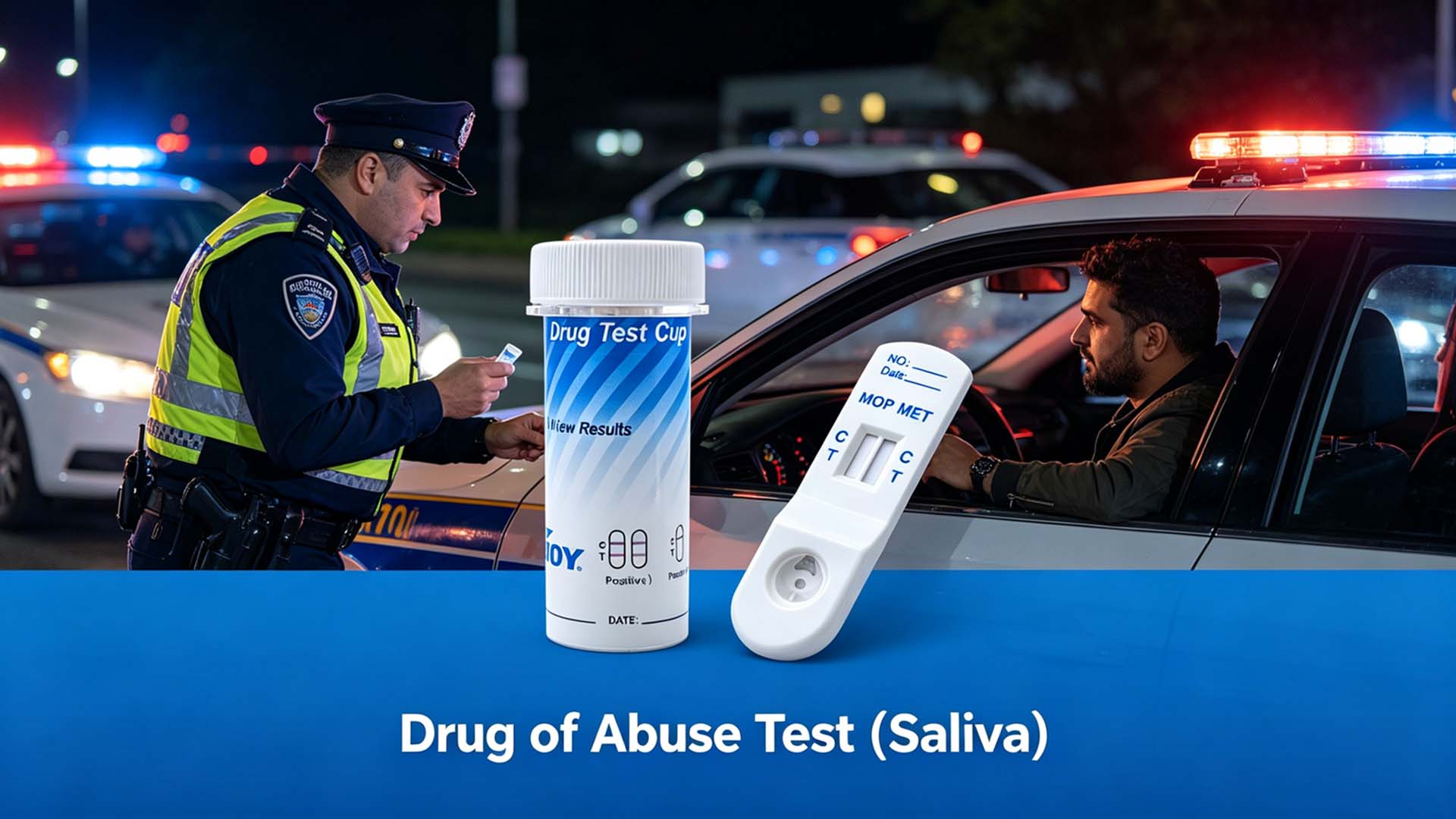
In practical applications, saliva detection technology has demonstrated a strong ability to adapt to various scenarios. In the field of traffic law enforcement, traffic police only need to hold a detection reagent to quickly identify suspects of drug driving on the roadside. The entire process takes no more than five minutes, significantly enhancing the efficiency of law enforcement. In the anti-drug work on campus, saliva testing can be used as a routine screening method. Under the premise of not affecting the normal teaching order, students involved in drugs can be identified in a timely manner and intervention can be carried out. Medical institutions also use it for emergency rapid diagnosis to help doctors determine whether patients have consciousness disorders due to drug abuse, thereby formulating more precise treatment plans. According to data from the US Department of Transportation, after the adoption of saliva testing, the efficiency of drug driving detection has increased by 400%, and the missed detection rate has dropped below 1%. drug test kit
However, saliva testing technology is not perfect. Its detection window is relatively short, usually only reflecting recent (several hours to several days) drug use behavior, and it may not be effective in detecting long-term drug users. In addition, the concentration of drugs in saliva is relatively low, which requires a higher sensitivity of detection techniques and may lead to false positive or false negative results. To make up for these deficiencies, the current mainstream approach is to use saliva testing as an initial screening method, and then conduct laboratory blood tests to confirm positive results.
With the advancement of technology, saliva detection technology is developing in a multi-dimensional and intelligent direction. The new generation of detection reagents can simultaneously test over ten types of drugs and their metabolites, covering traditional drugs, synthetic drugs and new psychoactive substances. Some intelligent detection devices can also achieve real-time data upload and cloud analysis, providing drug situation early warnings for anti-drug departments. In the future, by integrating technologies such as microfluidic chips and nanosensors, saliva detection is expected to achieve more precise quantitative analysis. It may even be possible to determine the frequency and dosage of drug use through saliva samples, providing a scientific basis for drug rehabilitation treatment.
The rise of saliva drug detection technology is not only an innovation in detection methods but also an upgrade in anti-drug concepts. It has shifted drug testing from “passive waiting” to “active prevention and control”, and from “professional laboratories” to “streets and alleys”. In today’s world where the forms of drugs are constantly evolving and their transmission methods are becoming increasingly covert, this rapid and convenient detection technology is becoming an “invisible defense line” for safeguarding social security, helping us detect drug traces earlier, cut off the transmission chain more quickly, and ultimately achieve the goal of a “drug-free society”.
Post time: Jun-29-2026