

The documentary film “Typhoid Mary” tells the story of Mary Mullen’s life. She was the first healthy carrier of typhoid fever discovered in the United States and was thus called “Typhoid Mary”. He was a chef and as a result, 53 people were infected and 3 died. Although more than 100 years have passed since the story of “Typhoid Mary”, it still causes a major disease burden in Africa and Asia. The World Health Organization (WHO) estimates that there are between 10 million and 20 million typhoid cases worldwide each year, with about 140,000 deaths. It has been found all over the world, with a higher incidence in developing countries and (subtropical) regions. In developed countries, most patients fall ill after traveling. In some developing countries, this is a disease that seriously threatens children’s health.
Typhoid fever is more common in school-aged children and young people. It can cause clinical manifestations such as high fever, systemic toxic symptoms, intestinal ulcers and relatively slow pulse in the human body. In severe cases, it may even threaten life. Although typhoid fever seems to be rarely encountered in daily life, it can be fatal when it is severe. Especially in the summer and autumn when typhoid fever is prevalent, it is necessary to pay attention and be careful not to “get sick through the mouth”!
I. What is Typhoid Fever
Typhoid fever is an acute infectious disease caused by Salmonella typhi infection through the digestive tract. It can be seen throughout the year, with the highest incidence in summer and autumn. Carriers and patients are the only sources of infection for typhoid fever, and it is mainly transmitted through the fecal-oral route. After being excreted, typhoid bacillus directly or indirectly contaminates food, water, tableware and other daily necessities, and then spreads through the mouth. Flies are important vectors of transmission.

Ii. Transmission Characteristics of Typhoid Fever
Typhoid carriers and patients are the sole sources of infection. Salmonella typhi is transmitted through the fecal-oral route. Ingesting contaminated food or water can cause the disease. Flies and cockroaches are also important vectors and can cause sporadic outbreaks of typhoid fever.
Women or elderly patients with biliary system diseases such as cholelithiasis or chronic cholecystitis are prone to become chronic carriers, and a few patients can excrete bacteria for life.
The general population is susceptible to typhoid fever, with children and young people being more common. After falling ill, a stable immune system can be acquired.
Iii. Symptoms of Typhoid Fever
Typhoid fever usually occurs as a febrile disease of unknown cause and is mostly treated as an outpatient disease in endemic areas. Symptoms appear within 10 to 14 days after exposure, including fever and discomfort, abdominal pain. Other symptoms include hepatosplenomegaly, diffuse abdominal tenderness, tongue coating, roseola, etc.
Iv. Diagnosis of Typhoid Fever
Blood culture: It is the main method for diagnosing typhoid fever and has a high positive rate.
02 Bone marrow culture: When blood culture is negative, bone marrow culture can be considered, as it has a higher positive rate.
03 Fecal culture: The positive rate gradually increases from the second week of the disease course, with the highest positive rate in the third to fourth weeks.
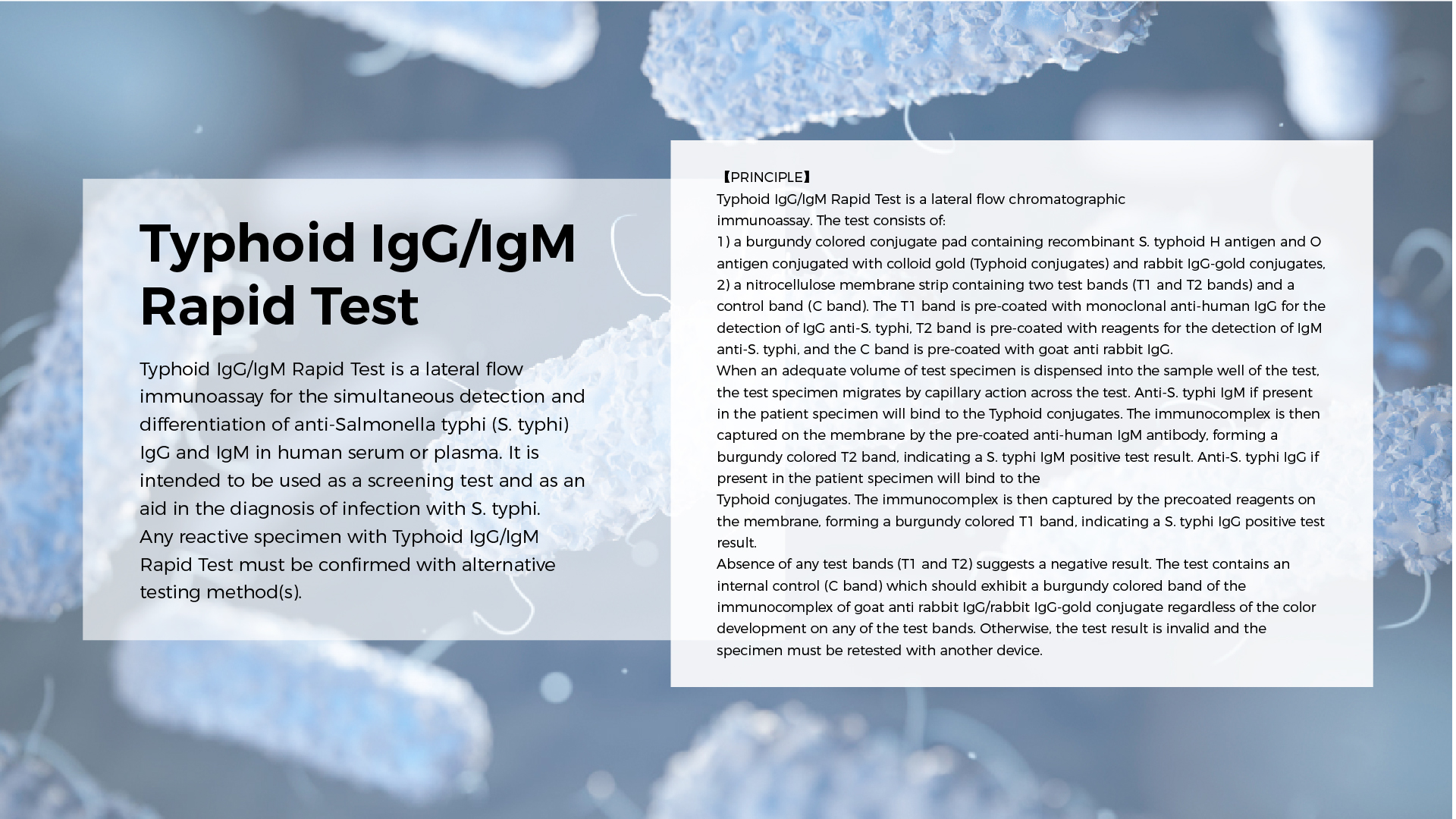
04 Immunological examination: such as the Fenda test, but it should be noted that its false positive and false negative rates are relatively high.
V. Treatment and Prevention of Typhoid Fever
01 Disinfection and Isolation: After admission, disinfection and isolation should be carried out in accordance with the routine for intestinal infectious diseases. After the clinical symptoms disappear, fecal samples should be sent for Salmonella typhi culture every 5 to 7 days. Isolation can only be lifted after two consecutive negative results.
02 Rest.
03 Strengthen care.
04 Diet: During the fever period, liquid or semi-liquid diets should be provided, with small and frequent meals. After the fever subsides, the diet should gradually transition from thin porridge to soft foods. It takes two weeks after the fever subsides before resuming normal diet. The diet should include sufficient carbohydrates, proteins and various vitamins to replenish the consumption during the fever period and promote recovery. Eating foods that are rich in residue, hard and prone to gas production too early poses a risk of inducing intestinal bleeding and perforation.
05 Use sensitive antibiotics in full doses and for a full course of treatment. Dr. Huang Jianrong, a chief physician, stated that typhoid fever is both preventable and treatable. Antibiotics can alleviate the symptoms of typhoid fever within a week and reduce the fatality rate from 10% to 30% to less than 1%. The key to prevention lies in “washing hands frequently, eating cooked food and not drinking unboiled water”. Improving water hygiene and sanitation facilities has successfully reduced the incidence of typhoid fever in many developed countries.
Post time: Jan-08-2026