

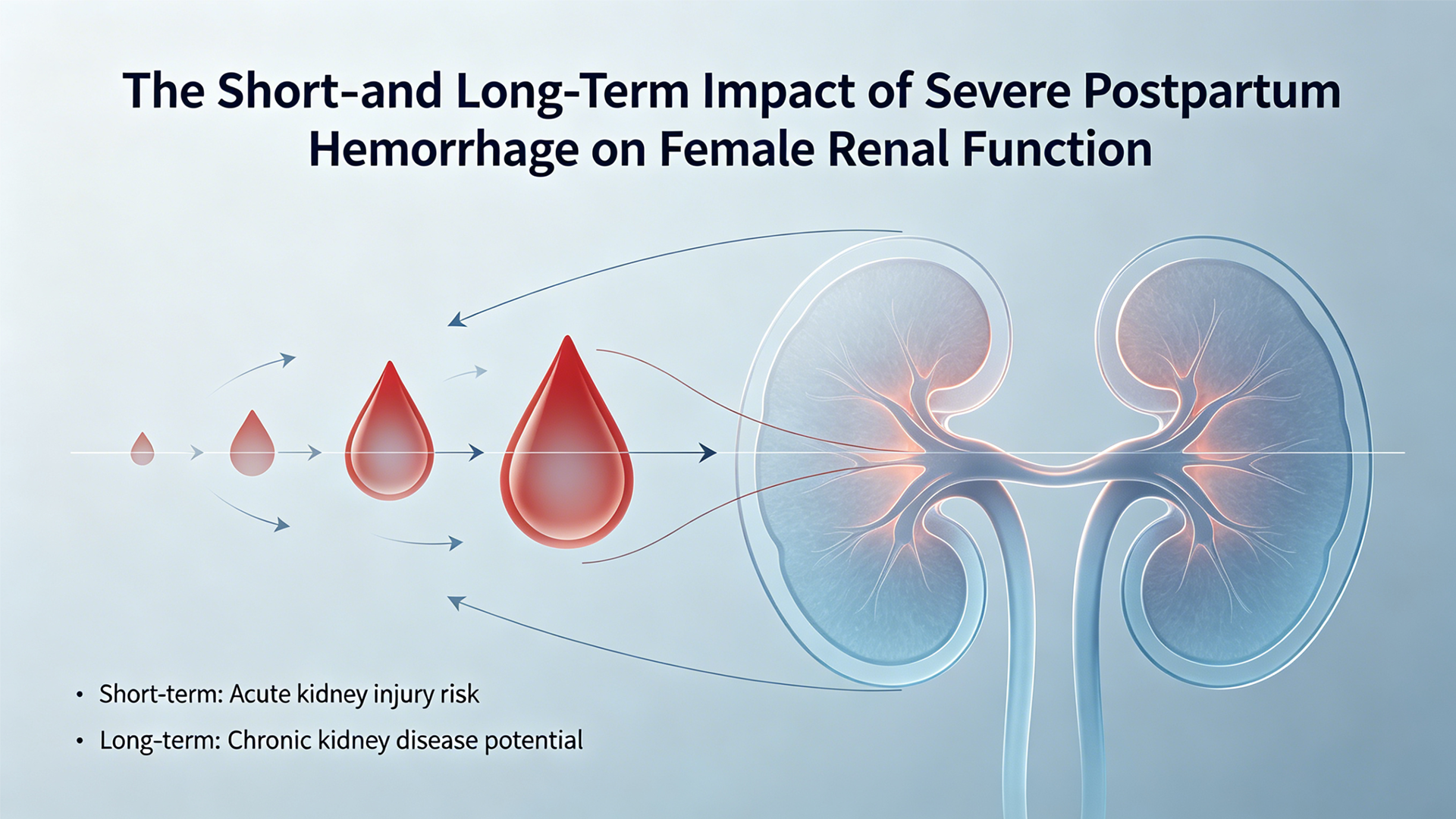
Postpartum hemorrhage is the most common and serious complication of pregnancy and the leading cause of maternal death in China. Severe postpartum hemorrhage can cause systemic hemodynamic instability and organ hypoperfusion, which in turn leads to multi-organ functional damage and even death. Recent studies have confirmed that adverse pregnancy outcomes significantly increase the risk of long-term chronic diseases in the mother. Among them, chronic kidney disease is one of the most concerned long-term complications – severe postpartum hemorrhage often first induces acute kidney injury (AKI), and if not well controlled, it will leave chronic kidney disease. The common pathogenic mechanisms include acute tubular necrosis caused by hypovolemic shock, acute renal cortical necrosis, disseminated intravascular coagulation (DIC), and complement mediated thrombotic microangulopathy (TMA) such as postpartum hemolytic uremic syndrome (HUS). This article sorts out the relevant contents. Urine test strips
I. Diagnosis and Current Status of AKI during Pregnancy
The current globally recognized AKI diagnostic criteria of the 2012 version of the Global Organization for Improving Prognosis of Kidney Disease (KDIGO) can be diagnosed if any of the following conditions are met: serum creatinine increase ≥26.5μmol/L within 48 hours, or creatinine rise to 1.5 times or more of the baseline value within 7 days, or urine output ≤0.5ml/(kg·h) for 6 hours. However, this standard has not been corrected for pregnant women: Pregnant women may experience an increase in physiological glomerular filtration rate by approximately 50%, and their baseline creatinine levels are much lower than those of healthy non-pregnant women. Moreover, most pregnant women do not have pre-pregnancy baseline creatinine data and their renal function is not monitored regularly and sequendiatively during pregnancy. Using non-pregnancy standards can easily lead to missed diagnoses. Currently, there is still a lack of a unified corrected diagnostic standard for AKI during pregnancy.
In recent years, with the delay of childbearing age and the increase of underlying complications in pregnant women, the global incidence of AKI during pregnancy has been on the rise. The incidence in the United States has increased threefold over the past 20 years, and the overall incidence in China is 0.2% to 1.8%. Severe postpartum hemorrhage is the leading cause of postpartum AKI. The incidence of postpartum hemorrhagic AKI varies greatly among different studies, ranging from 3.26% in a single-center study in India to 71% in a study in the UK.
Ii. Clinical Identification of AKI Related to Severe Postpartum Hemorrhage
Severe postpartum hemorrhage can induce AKI through multiple mechanisms. Clinically, a systematic examination is needed to determine the degree of injury and the cause: routine tests include urine tests using test strips + microscopic examination of urine sediment, quantitative urine protein, blood routine + peripheral blood smear, hemolysis-related indicators (bilirubin, globin, lactate dehydrogenase), and liver and kidney function tests. Renal pre-renal injury caused by insufficient volume usually shows no abnormal urine test results, almost no proteinuria, and can recover quickly after fluid replacement to correct hypotension. The presence of colored granular casts and renal tubular epithelial cells in urine sediment indicates acute renal tubular necrosis. If renal function does not recover well after active treatment, renal cortical necrosis should be suspected, which can be confirmed through imaging examinations. If the severity of the disease does not match the degree of renal function impairment, especially when accompanied by persistent anuria, it is necessary to be highly vigilant about complement-mediated TMA and complete the detection of complement-related proteins. Urine analysis test
Iii. Potential Impact of Treatment on Renal Function
Severe postpartum hemorrhage itself does not directly lead to AKI. The core causes are volume insufficiency, ischemia-reperfusion injury, DIC and TMA caused by blood loss. Therefore, early identification of high-risk factors, initiation of treatment procedures, maintenance of hemodynamic stability and tissue perfusion are the keys to reducing the risk of AKI. During the treatment process, it is necessary to avoid using contrast agents for imaging examinations as much as possible to reduce additional kidney damage.
There is controversy over the risk of renal injury associated with tranexamic acid, a first-line hemostatic drug: High-quality studies have confirmed that tranoic acid can reduce the risk of death from postpartum hemorrhage by 20% to 30%, without increasing the risk of arteriovenous thrombosis. Only occasionally have there been reports that it may induce acute renal cortical necrosis, but this risk is extremely low. Moreover, all related cases are accompanied by insufficient renal perfusion caused by massive blood loss itself. Therefore, it is still recommended to use it actively when the indications for medication are met. Urine analysis reagent
Iv. Short-term and Long-Term Prognosis
Overall, approximately 2.4% of AKI during pregnancy will progress to end-stage renal disease requiring maintenance dialysis. The poor long-term prognosis of AKI related to severe postpartum hemorrhage is mainly secondary to three types of situations: First, DIC: Severe postpartum hemorrhage is the most common cause of obstetric DIC. About 32.2% of obstetric DIC cases are complicated with AKI, and most require renal replacement therapy. However, there is currently a lack of large-sample long-term follow-up data to clarify its impact on long-term renal function. Second, renal cortical necrosis: This is a rare but serious type of AKI. The incidence rate in developing countries is higher than that in developed countries, and 30% to 50% of patients will progress to end-stage renal disease. Third, complement-mediated TMA-HUS: It is very rare for postpartum hemorrhage to induce this disease, but the renal function impairment is severe. 71% of patients require dialysis, and 53% will progress to end-stage renal disease. In recent years, the application of the complement inhibitor ecucuzumab has significantly improved prognosis. Its safety during pregnancy and postpartum has been confirmed, and it can effectively improve renal outcomes.
For people with chronic kidney disease before pregnancy, the progression of chronic kidney disease in stages 1 to 2 before pregnancy is rarely accelerated due to pregnancy. However, for patients in stages 3 to 5, the rate of decline in renal function significantly accelerates after pregnancy. If preeclampsia occurs simultaneously, it will further accelerate the damage. But the impact of postpartum hemorrhage on the long-term renal function of this population still requires more research.
In conclusion, the impact of severe postpartum hemorrhage on the long-term renal function of women mainly occurs secondary to perinatal AKI. Hemodynamic disorders, abnormal coagulation function, and complion-related TMA are the core pathogenic mechanisms. Early identification of high-risk factors, standardized treatment, and maintenance of effective tissue perfusion are of great significance for reducing the occurrence of AKI and improving the long-term renal prognosis of the mother.
Post time: Jun-25-2026